
When people think about Disney icons, characters like Mickey Mouse, Donald Duck, and Goofy usually dominate the conversation. Yet one of the company’s most enduring and emotionally recognizable characters has always been the quietest one in the room.
Pluto never needed catchphrases, complicated dialogue, or dramatic storylines to become beloved across generations.
He simply needed personality.
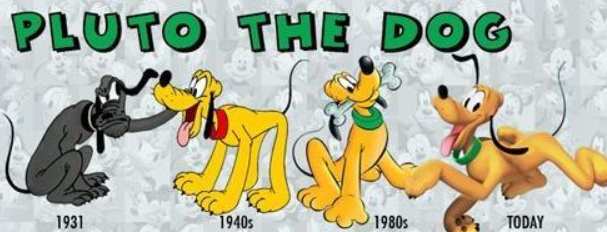
Over the decades, Pluto evolved from a basic cartoon dog into one of Disney’s most expressive and emotionally relatable characters. His journey reflects not only the changing style of animation but also Disney’s growing understanding of visual storytelling.
And in many ways, Pluto became proof that silence can sometimes create the strongest connection of all.
Pluto’s Early Beginnings
Pluto first appeared in 1930 during the early years of Disney animation. Originally introduced as a bloodhound named Rover in The Chain Gang, the character quickly evolved into Mickey Mouse’s pet dog.
At the time, Disney animation was still experimenting with how animal characters should behave. Many animated animals wore clothes, talked like humans, and acted almost identically to people.
Pluto was different.
Unlike Mickey, Donald, or Goofy, Pluto remained a real dog.
He walked on four legs.
He barked.
He chased bones.
He wagged his tail.
That choice may seem simple today, but it fundamentally separated Pluto from nearly every major Disney character around him.
Ironically, this limitation became his greatest strength.
The Character That Relied on Emotion
Because Pluto couldn’t speak, Disney animators had to communicate everything through body language and facial expression.
This forced a level of creativity that pushed animation forward.
Animators gave Pluto oversized reactions, exaggerated movements, nervous habits, and deeply human emotions without ever making him stop feeling like a dog.
Viewers understood when Pluto was jealous.
They understood when he felt guilty.
They understood when he was excited, frightened, confused, or heartbroken.
All without dialogue.
This style of visual acting became one of the foundations of classic Disney animation.
In many Pluto cartoons, the audience spends several minutes completely focused on his emotional state without needing a single spoken sentence.
That takes remarkable storytelling skill.
Pluto in the Golden Age of Disney Shorts
During the 1930s and 1940s, Pluto became a major star in Disney’s growing lineup of theatrical shorts.
Many of these cartoons focused entirely on everyday situations:
- Protecting a bone
- Chasing small animals
- Avoiding trouble
- Trying to impress Mickey
- Dealing with chaos caused by curiosity
The brilliance of these stories was their simplicity.
Pluto wasn’t saving the world.
He wasn’t fighting villains.
He was dealing with relatable problems in exaggerated cartoon form.
This grounded approach made him surprisingly timeless.
Shorts like The Pointer, Pluto’s Sweater, and Canine Patrol showcased Disney’s increasing confidence in physical comedy and emotional animation.
At the same time, Pluto helped animators experiment with pacing, reaction timing, and visual humor in ways that would later influence larger Disney productions.
The Strange Contrast Between Pluto and Goofy
One of the most fascinating aspects of Disney history is the contrast between Pluto and Goofy.
Both characters are technically dogs.
Yet one behaves like a household pet while the other acts like a fully functioning human.
For decades, audiences have joked about this bizarre dynamic, but it actually highlights Disney’s flexibility in character design.
Goofy represented exaggerated human comedy.
Pluto represented emotional realism.
Disney intentionally kept Pluto grounded because his appeal came from recognizable animal behavior mixed with emotional storytelling.
That balance helped Pluto remain relatable even as Disney’s world became increasingly fantastical.
Animation Techniques That Changed Pluto Forever
As Disney animation evolved, Pluto’s design and movement evolved with it.
Early Pluto cartoons featured simpler movement and rougher animation styles common during the early sound era. But by the late 1930s, Disney artists had dramatically improved character fluidity and expression.
Pluto became one of the studio’s greatest tools for testing advanced animation techniques.
His ears moved independently.
His facial expressions became more detailed.
His reactions gained subtle emotional timing.
Even small movements like scratching, blinking, or shifting posture became carefully animated moments designed to create personality.
Disney animators studied real dogs extensively to make Pluto believable while still maintaining cartoon exaggeration.
This blend of realism and caricature became a major part of Disney’s animation identity.
Why Pluto Connected So Deeply with Audiences
Part of Pluto’s success comes from how emotionally vulnerable he feels.
Unlike many cartoon characters who confidently move through chaos, Pluto often struggles.
He gets embarrassed.
He becomes overwhelmed.
He panics.
He fails.
But he keeps trying.
That emotional sincerity made him feel genuine in a way many animated characters did not.
Children connected with Pluto because his emotions were easy to understand.
Adults appreciated the incredible craftsmanship behind his animation.
And animal lovers recognized behaviors that felt authentic.
Few Disney characters managed to appeal across so many different levels simultaneously.
Pluto’s Role in Modern Disney
Although Pluto no longer dominates theatrical animation the way he once did, the character remains one of Disney’s most recognizable icons.
He continues appearing in:
- Theme parks
- Merchandise
- Television specials
- Animated series
- Holiday promotions
- Disney marketing campaigns
What’s impressive is that Pluto’s core personality has remained remarkably consistent for nearly a century.
Even modern versions of the character still rely heavily on visual humor, loyalty, curiosity, and expressive animation.
Disney never tried to reinvent Pluto into something louder or trendier.
Instead, they preserved the qualities that made him work in the first place.
That consistency helped maintain his timeless appeal.
The Legacy of a Silent Character
Pluto’s influence on animation is often underestimated because he lacks the flashy personality of other Disney stars.
But in many ways, he helped define Disney storytelling.
His cartoons demonstrated that strong animation could communicate emotion more effectively than dialogue alone.
They showed how body language could create empathy.
And they proved that audiences would deeply connect with a character built almost entirely through visual performance.
Without Pluto, Disney’s emotional animation style may have developed very differently.
His legacy exists not only in Disney history but in animation itself.
Final Thoughts
The evolution of Pluto is really the story of Disney learning how to create emotional connection through movement, expression, and visual storytelling.
While louder characters grabbed attention, Pluto quietly became one of the studio’s most important creative achievements.
He never needed dramatic speeches.
He never needed complicated plots.
He only needed heart.
And nearly a hundred years later, that simple formula still works.
In a world full of animated characters constantly trying to become bigger, funnier, or more extreme, Pluto remains timeless because he represents something much simpler:
Loyalty, emotion, and the universal language of expression.


Leave a Reply