
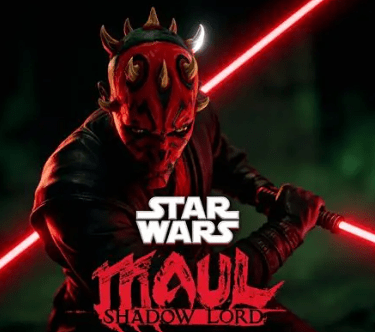
The latest two episodes of Maul: Shadow Lord don’t just raise the stakes — they completely change the tone of the series. Episodes 7 and 8 dive deeper into Maul’s fractured mind, his growing paranoia, and the brutal consequences of trying to rule through fear alone. If the earlier episodes were about power, these chapters are about decay.
And honestly? This is the version of Maul Star Wars has needed for years.
Episode 7 – The Throne Starts Cracking
Episode 7 opens with one of the strongest visual sequences in the series so far. Maul stands alone in the ruined chamber beneath Ord Vaxal while the holographic remains of his criminal empire flicker around him like ghosts. No dialogue. No soundtrack. Just the sound of unstable machinery and distant thunder.
That silence says everything.
Maul is losing control.
Throughout the episode, we watch his syndicate begin collapsing from the inside. The Black Sun captains no longer fear him the way they once did, the Pyke representatives openly question his judgment, and even his own followers seem exhausted by endless war.
What makes Episode 7 work so well is that it avoids turning Maul into a generic villain. He isn’t angry because he’s evil. He’s angry because he’s terrified. Every scene reinforces the idea that Maul cannot survive without conflict. Peace would force him to confront who he really is beneath the rage.
The confrontation between Maul and Talis Ren might be the best written dialogue exchange in the entire season.
Talis tells him:
“You conquered worlds but never escaped the cage they built for you.”
That line hits hard because it cuts directly into Maul’s identity. He spent years blaming Sidious, Kenobi, and the Jedi for his suffering, but Episode 7 suggests something darker:
Maul has become addicted to vengeance.
Even after everything, he still defines himself through hatred.
The fight sequence at the refinery is also incredible. Not because it’s flashy — although the choreography is excellent — but because every movement feels desperate. Maul fights like a cornered predator. Brutal. Fast. Sloppy at times. The animators clearly wanted him to look exhausted rather than unstoppable.
That decision makes him feel more dangerous.
By the end of the episode, when the refinery explodes and half his remaining forces abandon him, it becomes obvious that the “Shadow Lord” title is turning into a curse.
He rules nothing.
He only survives.
Episode 8 – Rage Becomes Madness
If Episode 7 is about collapse, Episode 8 is about transformation.
This episode fully embraces psychological horror in a way Star Wars rarely attempts. The hallucination scenes alone are some of the darkest material the franchise has produced in animation.
The sequence where Maul walks through the abandoned Sith temple while hearing voices from his past is genuinely unsettling. Qui-Gon. Savage. Mother Talzin. Sidious. Kenobi.
They all haunt him.
But the most disturbing part is that some of those voices may not even be hallucinations.
The series cleverly leaves enough ambiguity to suggest the dark side itself is feeding on Maul’s fractured mind. Every vision pushes him further away from reality and deeper into obsession.
The Kenobi vision especially stands out.
Instead of appearing triumphant or heroic, Kenobi looks tired. Older. Almost sympathetic. And that completely destroys Maul emotionally because sympathy is the one thing he cannot tolerate.
He would rather be hated.
The writing in Episode 8 finally understands that Maul’s greatest enemy was never Obi-Wan.
It was emptiness.
Without revenge, without war, without someone to blame, Maul has no identity left.
That realization drives the entire episode toward its devastating ending.
The Final Duel Wasn’t Really a Duel
A lot of fans expected Episode 8 to end with some massive lightsaber battle.
Instead, the creators did something smarter.
The final confrontation between Maul and Talis Ren is mostly verbal. There’s action, yes, but emotionally the scene works because Talis refuses to fight him the way he wants.
Maul wants conflict.
Talis denies him that satisfaction.
The moment where she deactivates her blade and tells him:
“You already lost yourself long ago.”
might be the most important moment in the entire show.
Because for the first time, Maul has no response.
No screaming.
No threats.
No rage.
Just silence.
It’s terrifying.
Why These Episodes Work So Well
Episodes 7 and 8 succeed because they stop treating Maul like a cool action character and start treating him like a tragic horror figure.
That distinction matters.
For years, Star Wars stories leaned heavily into Maul’s visual appeal — the double-bladed saber, the acrobatics, the intimidation factor. But these episodes finally explore the psychological consequences of a life built entirely around pain.
Maul isn’t powerful anymore.
He’s hollow.
And somehow that makes him more compelling than ever.
The pacing is slower, the dialogue is heavier, and the atmosphere feels almost oppressive throughout both episodes. Some viewers will probably complain that “nothing happens,” but that criticism completely misses the point.
Everything happening internally is far more important than another giant battle scene.
The Bigger Question Moving Forward
After Episode 8, the biggest mystery isn’t whether Maul survives.
It’s whether there’s anything left worth saving.
The series seems increasingly interested in the idea that dark side users eventually become prisoners of their own emotions. Maul spent his entire life chasing revenge only to discover revenge cannot sustain a person forever.
That’s what makes these episodes surprisingly tragic.
Not because Maul deserves redemption.
But because he never learned how to exist without suffering.
Final Thoughts
Episodes 7 and 8 are easily the strongest stretch of Maul: Shadow Lord so far. They trade nonstop action for atmosphere, psychological tension, and character depth — and the series is far better because of it.
This version of Maul feels dangerous, broken, intelligent, and deeply human all at once.
More importantly, the show finally understands that the scariest villains are not the ones who crave power.
They’re the ones who no longer know who they are without it.
If the remaining episodes maintain this level of writing and emotional weight, Maul: Shadow Lord could end up becoming one of the most memorable Star Wars stories in years.


Leave a Reply