
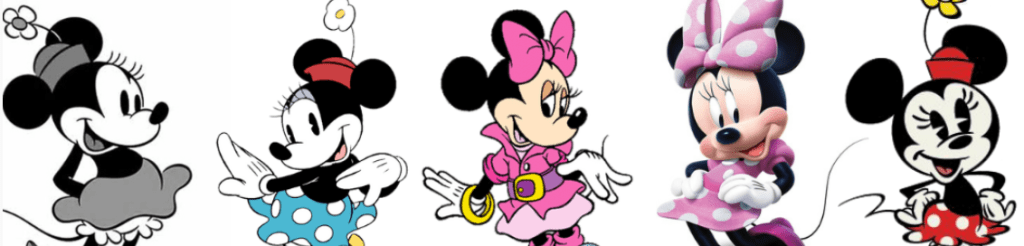
When people think of classic animation icons, Minnie Mouse often comes to mind instantly—her bow perched perfectly, her heels clicking confidently, and her unmistakable charm lighting up the screen. Yet beneath that seemingly simple design lies one of the most quietly transformative journeys in animation history. Minnie hasn’t just existed alongside Mickey Mouse—she has adapted, expanded, and redefined herself across generations in ways that mirror cultural shifts, artistic evolution, and changing expectations of female characters.
1920s–1930s: A Spirited Beginning in a New Medium
Minnie Mouse made her official debut in 1928 in Steamboat Willie, a landmark in animation history as one of the first cartoons to successfully synchronize sound with motion. From her earliest appearance, Minnie was not just a background figure. She was expressive, lively, and playful traits that helped establish her as more than simply Mickey’s companion.
In early shorts like Plane Crazy and The Gallopin’ Gaucho, Minnie displayed a boldness that sometimes gets overlooked today. She could be flirtatious, quick-witted, and even a bit rebellious. These early portrayals reflected the “flapper” archetype of the late 1920s—a woman who embraced modernity, independence, and a playful disregard for rigid social norms.
However, as animation matured and studios refined their storytelling, Minnie’s character began to shift. By the mid-1930s, narratives became more structured, and character roles more clearly defined. Minnie transitioned into a gentler, more traditionally feminine role—often kind, supportive, and less central to the action. While this reflected broader societal expectations of the time, it also marked the beginning of a long period where her potential wasn’t fully explored on screen.
1940s–1960s: The Era of Stability and Symbolism
During the mid-20th century, Minnie Mouse’s presence in animated films became less frequent, but her importance as a brand icon grew significantly. She appeared in comics, merchandise, and promotional material, becoming one of the most recognizable characters associated with The Walt Disney Company.
While Mickey often led theatrical releases and new projects, Minnie maintained a consistent identity. Her design became standardized—red or pink polka-dot dress, bow, and heels—creating a visual shorthand that audiences around the world could instantly recognize.
This era is sometimes seen as a quieter phase for Minnie in terms of character development, but it played a crucial role in solidifying her legacy. She became timeless. Even without major narrative arcs, she remained relevant through familiarity and visual consistency.
1970s–1990s: Reintroduction to New Generations
As Disney expanded into television and new forms of media, Minnie began to reappear more regularly. Shows, specials, and theme park experiences brought her back into the spotlight, albeit often still within a supporting role.
What changed during this period was context. Audiences were evolving, and so were expectations around storytelling and character dynamics. Minnie began to show more personality again—subtle at first, but noticeable. She wasn’t just present; she was participating.
Her role in theme parks, in particular, helped redefine her image. Meeting Minnie in person—interacting with her, seeing her as cheerful, confident, and welcoming—gave audiences a more active sense of who she was. She became not just a character on screen, but an experience.
2000s–2010s: A Confident Reinvention
The 21st century marked a major turning point for Minnie Mouse. With the launch of shows like Mickey Mouse Clubhouse, she took on a more active and capable role. This version of Minnie was resourceful, organized, and often central to solving problems. She wasn’t just accompanying adventures—she was helping lead them.
Then came the stylistically bold Mickey Mouse (2013 series), which reimagined classic characters with a modern, comedic edge. Here, Minnie’s personality expanded dramatically. She became sharper, more expressive, and often delightfully unpredictable. The animation style allowed for exaggerated reactions and faster pacing, giving Minnie room to showcase humor and confidence in new ways.
Perhaps one of the most significant developments was Minnie’s Bow-Toons. In this series, Minnie stepped fully into her own narrative space. Running a bow boutique and going on her own adventures, she was no longer defined primarily by her relationship with Mickey. She became entrepreneurial, creative, and independent—a character with her own goals and identity.
Fashion, Culture, and Global Influence
Minnie Mouse’s evolution isn’t limited to animation. Over the decades, she has become a global fashion icon. Designers have reinterpreted her look countless times, blending her classic aesthetic with contemporary trends. Despite these variations, her core identity remains intact—a testament to the strength of her original design.
Her influence extends beyond clothing. Minnie represents a particular blend of elegance and playfulness that resonates across cultures. Whether in theme parks, collaborations, or media appearances, she embodies a style that feels both nostalgic and current.
In 2018, Minnie received a star on the Hollywood Walk of Fame, honoring her decades of cultural impact. The recognition highlighted something fans have long understood: Minnie Mouse isn’t just a side character—she’s a cornerstone of animation history.
Modern Minnie: Balancing Tradition and Progress
Today’s Minnie Mouse is a carefully balanced character. She retains the warmth, kindness, and charm that defined her early years, but she’s also confident, capable, and independent. She can lead, create, solve problems, and express herself fully—all while remaining unmistakably Minnie.
What makes her evolution so fascinating is that it hasn’t been abrupt. Unlike characters who undergo dramatic reboots, Minnie has changed gradually, reflecting shifts in both storytelling and society. She has grown alongside her audience, adapting without losing her identity.
Why Minnie’s Evolution Matters
Minnie Mouse’s journey tells a larger story about animation and representation. She began as a lively co-star, became a symbol of tradition, and eventually emerged as a fully realized character in her own right. Her evolution mirrors broader changes in how female characters are written—moving from supportive roles to central, dynamic figures.
And yet, through all these changes, Minnie has remained approachable and familiar. Her bow, her smile, her unmistakable silhouette—they’ve stayed constant even as her personality deepened.
That’s the magic of Minnie Mouse. She proves that evolution doesn’t always require reinvention. Sometimes, it’s about growth, refinement, and the quiet confidence to step forward—one polka dot at a time.


Leave a Reply